- Registry documentation quality directly impacts abstraction accuracy
- Incomplete or unclear documentation increases registry risk
- Strong documentation reduces abstraction time and rework
- High-quality documentation supports audits and value-based care
- Aligning clinicians and registry teams improves outcomes
Introduction: The Overlooked Link Between Documentation and Registry Performance
Clinical registries rely on accurate abstraction—but abstraction quality is only as strong as the documentation behind it. As healthcare organizations move further into value-based care models, documentation quality has become a critical factor in registry success.
Poor or inconsistent documentation doesn’t just slow down data abstractors—it introduces risk, increases rework, and undermines confidence in reported outcomes. Improving registry documentation quality is no longer optional; it’s foundational to performance, compliance, and reimbursement.
What Is Registry Documentation Quality?
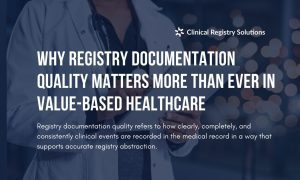
Registry documentation quality refers to how clearly, completely, and consistently clinical events are recorded in the medical record in a way that supports accurate registry abstraction.
High-quality documentation is:
- Complete and timely
- Aligned with registry definitions
- Consistent across care teams
- Easy to interpret without assumptions
When documentation quality is strong, registry abstraction becomes more efficient and defensible.
How Poor Documentation Impacts Data Registry Accuracy
Incomplete or ambiguous documentation often leads to:
- Interpretation variability among remote and in-person abstractors
- Increased data validation discrepancies
- Delayed submissions due to clarification needs
- Greater audit exposure
Even highly skilled abstractors cannot compensate for documentation gaps. Over time, these issues compound and affect registry benchmarks and quality scores.
The Role of Documentation in Value-Based Care Reporting
Value-based care models depend on reliable data to measure outcomes, quality, and performance. Registry data frequently feeds into:
- Quality dashboards
- Benchmark comparisons
- Performance improvement initiatives
When documentation quality is inconsistent, registry data may not accurately reflect patient care—impacting both internal decision-making and external reporting.
Improving Collaboration Between Clinicians and Remote Data Abstraction Registry Teams
One of the most effective ways to improve documentation quality is fostering collaboration between clinicians and registry professionals.
Successful organizations:
- Educate clinicians on why documentation supports registry accuracy
- Share examples of documentation challenges and downstream impact
- Align documentation practices with registry requirements
This shared understanding reduces friction and improves data quality at the source.
Long-Term Benefits of Strong Documentation Practices
Investing in documentation quality delivers lasting value:
- Faster medical record abstraction and validation cycles
- Reduced rework and clarification requests
- Improved audit readiness
- Greater confidence in registry-driven insights
Over time, strong documentation practices elevate the entire registry program.
Conclusion: Documentation Is the Foundation of Registry Success
Registry performance doesn’t start with abstraction—it starts with documentation. As value-based care continues to evolve, organizations that prioritize documentation quality will be better positioned to ensure accurate reporting, reduce risk, and maximize the strategic value of their registry data.
Strong documentation isn’t just good clinical practice—it’s a competitive advantage.
Frequently Asked Questions
Q1: Why is documentation quality important for clinical registries?
Documentation quality ensures data abstractors can accurately capture required data elements without assumptions or interpretation gaps.
Q2: Can abstractors fix poor documentation?
No. Abstractors rely on what is documented; unclear or missing information increases risk and reduces accuracy.
Q3: How does documentation affect registry audits?
Auditors assess whether abstracted data is supported by documentation. Weak documentation increases audit findings.
Q4: Does documentation quality impact value-based care programs?
Yes. Registry data often supports value-based metrics, making documentation accuracy critical to performance measurement.
Q5: What is the first step to improving registry documentation quality?
Start by identifying common documentation gaps and educating clinical teams on how those gaps affect registry outcomes.